
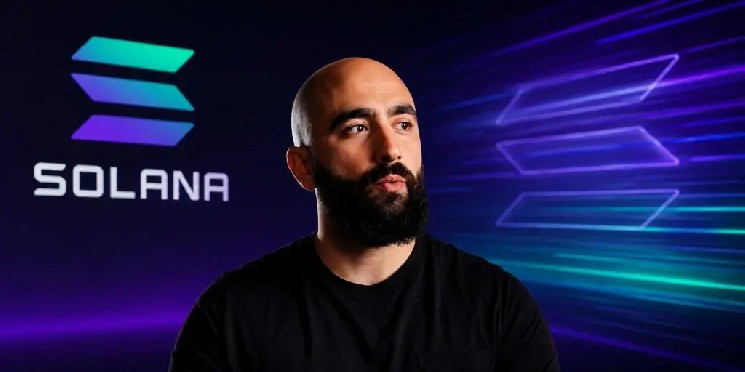
Mert Mumtaz, a prominent voice in the Solana community and the co‑founder and chief executive of Helius, shared his outlook on the cryptocurrency market, Bitcoin’s prevailing influence and the longer‑term prospects for altcoins during a recent interview.
Mumtaz argued that as the industry matures, Bitcoin’s grip on the rest of the market is likely to loosen. He pointed to projects such as Solana (SOL), Zcash (ZEC) and the trading platform Hyperliquid (HYPE) as examples of assets whose economic roles could eventually cause their prices to move independently of Bitcoin’s trajectory.
He acknowledged that Bitcoin’s dominance remains a key metric for the sector and recounted a meeting with a sovereign‑wealth‑fund representative who, despite the conversation, seemed to know little about anything beyond Bitcoin. According to Mumtaz, this limited awareness is not a reflection of Bitcoin’s technical superiority but rather a sign that many other crypto projects have not yet reached a comparable level of maturity.
“People often think Bitcoin is still in its infancy, but it’s actually well past that stage, which is why it’s so widely recognized,” he said. “Other projects are truly early‑stage. Solana, for instance, has only been able to scale consistently for about two years, and a lot of development still lies ahead.”
Mumtaz believes that Bitcoin’s dominance will become less decisive over time, and he cited Zcash as an early illustration of this shift. Referring to the ZEC/BTC trading pair, he noted that Zcash does not always track Bitcoin’s price movements.
He made a similar case for Hyperliquid, saying the platform’s economic model does not depend directly on Bitcoin’s price appreciation. A 30 percent decline in Bitcoin, he explained, would not automatically translate into a proportionally larger loss for Hyperliquid, because trading venues can generate revenue from volatility regardless of direction.
Regarding Solana, Mumtaz said the network is still misunderstood by many investors. He cautioned against viewing it merely as a blockchain or as a decentralized alternative to Nasdaq. Instead, he described Solana as the foundational infrastructure for internet‑based markets and programmable finance, suggesting that SOL could eventually serve as the currency of a growing digital economy.
He characterized Zcash as “encrypted Bitcoin,” proposing that the coin could act both as a store of value and as a form of digital cash for users who value privacy. Mumtaz emphasized that Zcash and Solana need not be direct competitors: Zcash can function as a financial asset, while Solana provides the underlying platform where that asset can be used as collateral or in other financial operations.
Mumtaz expressed confidence that Solana, Zcash and Bitcoin all have the potential to expand significantly in the long run. He added that Ethereum could be placed in the same group, though he does not feel as strongly about ETH as he does about the other three.
He identified the lack of financial privacy as one of the biggest hurdles to widespread, institutional adoption of blockchain technology. Citing the fact that banks and other financial institutions cannot expose client data on public ledgers, Mumtaz argued that without robust encryption mechanisms, the sector will struggle to achieve large‑scale institutional participation.
On the role of artificial intelligence, Mumtaz said the most important application for crypto will be security. He believes AI‑driven formal verification will make it easier to mathematically prove that smart contracts behave as intended.
Looking ahead, he predicted that improvements in scalability, clearer regulatory frameworks and advances in AI could give rise to entirely new financial products within the next few years.
Mumtax warned that many crypto investors make the mistake of focusing on short‑term price swings. He said daily fluctuations are insufficient for judging a project’s long‑term value. He recalled a period when Solana’s price fell to around $8, noting that the team kept building rather than abandoning the ecosystem. He offered similar long‑term perspectives for Zcash and NEAR.
*This commentary does not constitute investment advice.*
Source: CryptoNews.net