
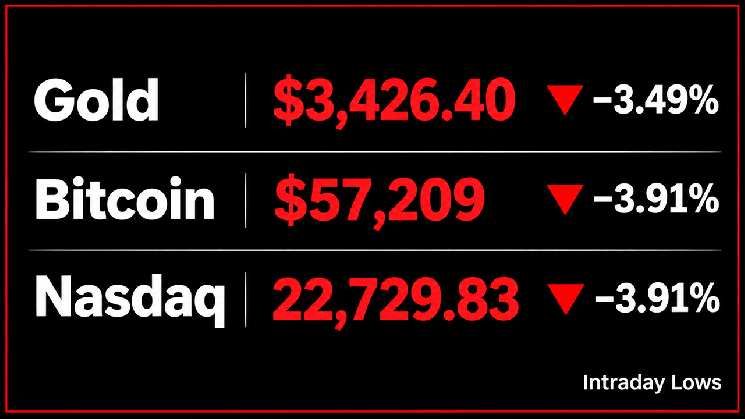
Wednesday’s market session turned sharply negative, with selling pressure hitting almost every major asset class ahead of the Thanksgiving holiday. The brief rally sparked by Nvidia on Monday has largely evaporated, leaving investors wrestling with fresh worries about AI‑related spending, tighter monetary policy and global trade frictions.
By about 10:20 a.m. Eastern, the Nasdaq Composite was down 3.91 % at 22,806.06, the S‑plus‑500 had slipped 2.72 % to 7,004.89, the Dow Jones Industrial Average fell 1.74 % to 49,149.61, and the NYSE Composite lost 0.92 % to 23,139.59. Earlier in the day the S‑plus‑500 briefly breached the 7,000‑point mark and the Nasdaq dipped to 22,729.83, but those figures reflect intraday readings rather than the day’s final numbers, as the session was still unfolding.
The sell‑off was not confined to equities. U.S. stocks collectively shed close to $2 trillion in market value, while precious metals and cryptocurrencies also suffered steep declines. Spot gold was quoted at $3,435.30 an ounce, down 3.49 % at 10:20 a.m., after briefly touching $3,426.40. Silver fell 6.53 % to $38.14, making it the weakest of the five precious metals tracked. Platinum dropped 3.78 % to $1,223 per ounce, palladium slipped 2.38 % to $821, and rhodium fell 3.37 % to $8,150.
Bitcoin’s price hovered around $57,200 on Bitstamp early Wednesday, nudging up to $57,746 by 10:30 a.m. Eastern. The cryptocurrency had been trading above $61,000 on Tuesday, and its cumulative loss for November was roughly 23 %. The Crypto Fear & Greed Index registered a reading of 13, signaling “extreme fear.” According to data from Coinglass, derivative liquidations totalled $510.96 million over the preceding 24 hours, affecting 126,557 traders. Long positions accounted for $422.73 million (about 82.7 % of the total), while short positions absorbed $88.23 million.
Bitcoin led the liquidation tally with $172.40 million, followed by ether at $80.82 million and gold‑linked contracts at $28.82 million. The biggest single liquidation occurred on Binance, where a $11.71 million long Bitcoin position was erased at $57,693.01. In the hour before the report, traders endured $168.57 million in forced liquidations.
The decline in both speculative assets and traditional safe‑havens suggests that investors may be prioritising cash over diversification. Selling gold alongside tech stocks and Bitcoin is consistent with attempts to raise liquidity, cut leverage or meet margin calls, though price moves alone cannot confirm motives.
Semiconductor shares were at the heart of the equity rout. Nvidia dropped roughly 8 % in early trade after a 6 % fall on Tuesday, erasing much of the dramatic bounce it enjoyed on Monday when CEO Jensen Huang returned to the helm. The iShares Semiconductor ETF (SOXX) slid 7 %, and stocks such as Advanced Micro Devices, Intel, Marvell, Applied Materials and Arm each fell more than 8 %. The Cboe Volatility Index (VIX), Wall Street’s fear gauge, jumped nearly 20 % to just under 32.
Economic data added to the mix of concerns. The personal consumption expenditures (PCE) price index rose 0.3 % in October, pushing annual inflation to 3.8 %. Core PCE inflation hit 3.3 %, above forecasts, while third‑quarter GDP was revised up to an annualised 4.3 %. CME FedWatch data showed traders assigning a 94 % probability to a rate hike in December and a 63 % chance of another increase in January, underscoring expectations of tighter monetary policy.
Trade tensions also weighed on sentiment. Reuters reported that the U.S. Trade Representative’s office was preparing a report on excess industrial capacity among 16 trading partners, including China and the European Union, a step that could lead to new tariffs.
Government bonds were one of the few bright spots, with the 10‑year U.S. Treasury yield easing toward 4.83 %.
With U.S. equity markets closed on Thursday and operating on a shortened schedule on Friday, trading liquidity is expected to be thin during this volatile stretch. Wednesday’s broad‑based losses highlight a market increasingly focused on preserving capital, even as assets traditionally viewed as safe havens are being sold off.
By 11 a.m., Bitcoin had managed to climb back above the $58,000 threshold, though how long that rebound will last remains uncertain. Despite the sharp market correction, JPMorgan continues to project an AI “supercycle” emerging around 2027.
Source: CryptoNews.net