
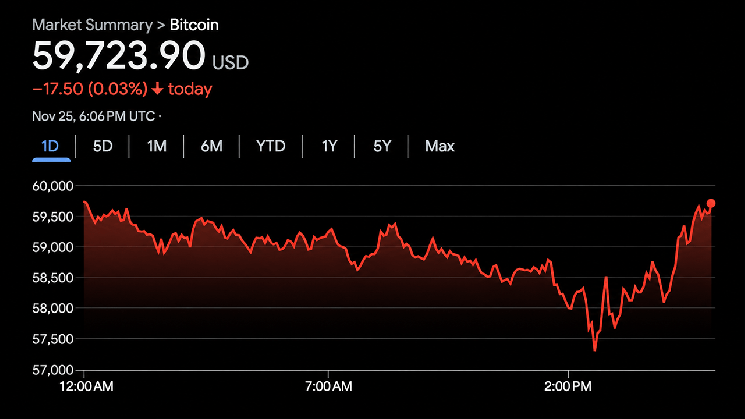
Bitcoin slipped for a second day in a row on Wednesday, with a pronounced dip in the mid‑morning session after reports emerged that the Trump administration intends to revive a tariff dispute with several of America’s key trading partners. The sell‑off erased the remaining optimism that Jensen Huang’s return to the Nvidia helm would spark a broader rally in the cryptocurrency market.
Data from the exchanges show that after hitting an intraday trough of $57,209 at 10:45 a.m. EST, the digital currency managed a short‑lived bounce, climbing back above $58,000 and briefly approaching $59,000 around midday. The rally was quickly reversed, pulling the price back toward $58,000 and extending a downtrend that had already taken Bitcoin from $60,000 down to roughly $58,500.
By 1:15 p.m. EST the coin was trading just under $59,723, reflecting a drop of about 1 percent over the previous 24 hours. That level represented a 7.41 percent fall from Monday’s high of $64,505 and a near‑25 percent decline since the start of the month. In total, roughly $95.5 billion has been erased from Bitcoin’s market value since Huang’s reinstatement briefly lifted the price above $64,000.
The price slide triggered a wave of derivatives liquidations. Bitcoin‑related contracts saw more than $213 million in positions closed, with nearly $138 million coming from long bets. Across the wider crypto market, total liquidations topped $579 million, of which $407 million were longs and $172 million were shorts.
Analysts at Bitfinex said the next two weeks will be defined not by the performance of U.S. tech stocks but by whether unleveraged spot buying returns before the crowded long positions are forced to unwind. “If spot buyers stay on the sidelines, the options market suggests dealer hedging could push the downside into the $58,000‑$64,000 band,” they warned, noting that Bitcoin was already hovering near the lower end of that range on Wednesday.
U.S. inflation continues to weigh on risk assets. Salman Parcy of Cequire Capital pointed to the October personal consumption expenditures (PCE) report, which showed both headline and core inflation rising 0.3 percent from the previous month and annual core PCE climbing to 3.3 percent, a touch above the 3.2 percent forecast. “This is rather bad news for crypto markets, as it creates a difficult monetary‑policy backdrop,” Parcy said. “The Fed has less room to cut rates, and the prospect of further tightening could keep liquidity tight, which hurts Bitcoin and other risk assets.” He added that, while the reading alone is not dramatically bearish, it makes a near‑term rebound more uncertain, hinging on better macro conditions and a renewed flow of institutional capital.
Bitfinex Alpha analysts also argued that Bitcoin’s lagging performance reflects a structural shift toward leveraged trading as spot investors pull back, leaving the price vulnerable to a rapid unwind of those leveraged bets. Since the Nasdaq‑100 hit its all‑time high on Oct. 6, Bitcoin has tended to lag equity rallies and suffer slightly larger losses when equities fall. Over the last 35 trading days, Bitcoin’s average gain on days the index rose was just 0.49 percent, compared with the index’s 1.67 percent. Conversely, on days the index fell, Bitcoin lost an average of 1.87 percent versus the index’s 1.73 percent decline. “Our reading is that holders of BTC are using strength in equity markets to exit positions at a loss or near breakeven,” the analysts wrote.
Although buying activity persists at current levels, the nature of demand has shifted from unleveraged spot accumulation to leveraged exposure. Investors have pulled almost $5 billion from spot exchange‑traded funds over the past month, and short‑term holders have been selling into equity market rallies. A market now propped up mainly by rising open interest and positive funding rates is becoming increasingly fragile.
Corporate and institutional appetite appears to be softening as sentiment deteriorates. Vugar Usi Zade, chief executive of the centralized exchange MEXC, said corporate demand is closely linked to market conditions and highlighted two notable changes since the summer. In June, Strategy launched a Bitcoin Monetization Program that permits the firm to sell BTC to fund reserves, dividend payouts and share buybacks. While Strategy has never been forced to sell and still holds $4.8 billion in U.S.‑dollar assets that it continues to replenish, Zade noted that investors can no longer assume with the same confidence as earlier in 2024 that the company will never liquidate its Bitcoin holdings.
The shift underscores that even the sector’s biggest corporate buyer is now prioritising balance‑sheet management over continued accumulation. Corporate treasury activity has also become uneven. Japan’s Metaplanet was among the few firms still buying back shares, repurchasing roughly 7 percent of its outstanding stock, while the U.K.‑based Satsuma Technology was liquidated by its owners. “In case there is a financial downturn, the biggest buyer moves from receiving coins to protecting the structure that funds them,” Zade said. He added that companies that treat financing costs and their own stock performance as primary risks will be better positioned to resume Bitcoin purchases when conditions improve, compared with those that view those considerations as secondary.
Source: CryptoNews.net